I used to yell, then feel guilty for hours. The script cards gave me the exact words to say during the morning meltdown. My son actually stopped, took a breath, and told me he was frustrated. First time ever.
Word-for-word scripts that help you stay calm, connect faster and guide your child through big emotions—without guessing what to say next.
Every meltdown feels different. Your words don't have to. Word-for-word scripts for the adult, plus the visual calm-down tools kids actually use - built around one simple loop: Steady, Connect, Guide.
Launch pricing ends soon
The bundle returns to $69 after the launch window. Set the date below and keep it.
Use the entire system for 30 days. If you don't feel more confident handling your child's biggest emotions, we'll refund you. Email us for a full refund. No forms. No hassle.
Most emotion bundles hand a worksheet to the child. This one also hands you the exact words.
Scripts for the adult, split into 3-6 and 7-11 — because a sentence that lands with a four-year-old sounds patronising to a nine-year-old.
The scripts are written for exactly that child — the one who escalates when reasoned with.
The first move is always the adult regulating, because a flooded child can't take in new information until your calm gives them something to borrow.
Print the 7-day quick-start path and the script cards first — roughly ten pages, covering the four moments most families struggle with.
The rest can wait for the weekend.
Join 50,000+ Parents Raising Emotionally Stronger Kids
I used to yell, then feel guilty for hours. The script cards gave me the exact words to say during the morning meltdown. My son actually stopped, took a breath, and told me he was frustrated. First time ever.
Bedtime used to be a war zone. We built the Calm Corner over a weekend and now my daughter walks herself over when she feels overwhelmed. Two weeks in and homework battles are basically gone.
I've read every parenting book. This is the first one that told me what to actually SAY. The Feelings Wheel changed everything - my daughter now names her emotions instead of just screaming. Game changer.
The 60-Second Resets saved me. I finally understand that I have to regulate first before I can help my son. Our sibling fights dropped by half in three weeks. I actually feel like a calm parent now.
Before. You know you should stay calm and validate. In the moment you lecture, negotiate, raise your voice — then lie awake feeling guilty.
After. You have the words on hand, in the same three steps every time.
You respond instead of react. And your child learns to name what they feel instead of only showing it.
A child mid-meltdown isn't refusing to use their coping skills — they've temporarily lost access to them. The thinking brain steps back, the survival brain takes over, and reasoning bounces off.
Children borrow regulation from the adult in front of them before they can produce their own. They read your face, your volume, your breathing.
So the first move in any hard moment isn't a technique for them. It's one for you.
That's the loop:
🟢 STEADY
Reset yourself first.
↓
🟡 CONNECT
Help your child feel understood.
↓
🔵 GUIDE
Move to a simple activity.
Teach the skill when everyone is calm. Run the loop when they're not.
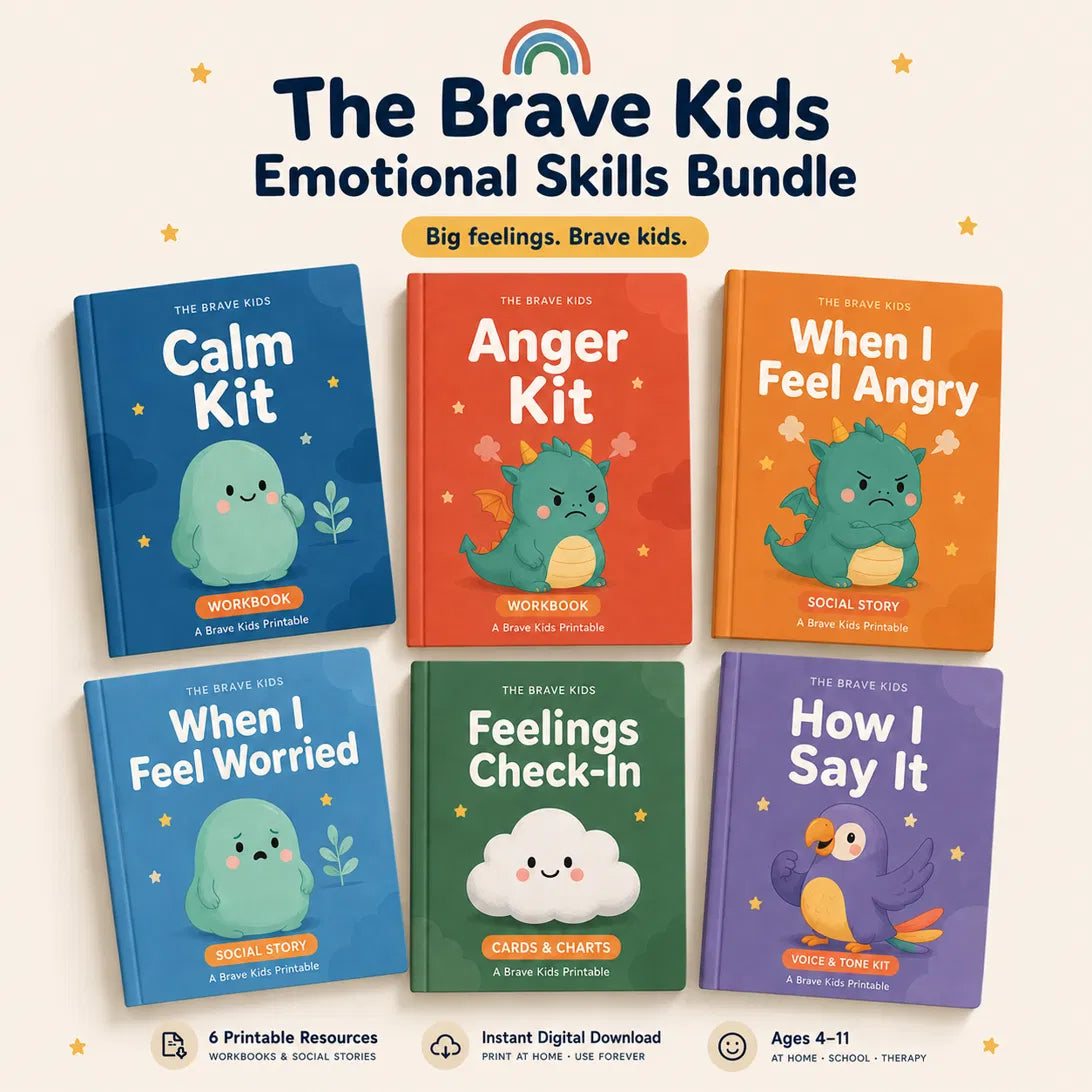
complete resources, built to work as one system rather than separate PDFs
Playbook, Calm Kit, Script Cards, Calm Corner, Resets, Trackerscripted scenarios, from homework meltdowns to public tantrums
Each written twice - once for ages 3-6, once for 7-11day quick-start path, so you're using it the day you buy it
Roughly ten pages to print first; the rest can wait| BRAVE KIDS | Others | |
|---|---|---|
| Word-for-word scripts for the adult | ✓ | ✗ |
| Wording split by age band (3-6 / 7-11) | ✓ | ✗ |
| One method across every page | ✓ | ✗ |
| Self-regulation tools for the parent | ✓ | ✗ |
| 7-day start path, not a pile of files | ✓ | ✗ |
| Screen-free, printable, unlimited reprints | ✓ | ✗ |
Six printable tools that reinforce each other - nothing here contradicts anything else.
Scripts for meltdowns, anger, anxiety and transitions, split by age, plus the 7-day quick-start path.
For the adult
Feelings wheel, body map, feelings thermometer, breathing cards and an I can calm down by board.
For the child
Quick-reference cards by scenario - homework, sibling fights, bedtime, public tantrums, negative self-talk.
Fridge or lanyard
Posters, a choice board and a setup checklist that turn any spare corner into a space your child goes to alone.
For the room
Self-regulation cards for the moment before you respond, because your calm is what the child borrows.
For the adult
A one-line-a-day log that surfaces the triggers and patterns you can't see from inside the moment.
For bothThree to eleven. The playbook and cards come in two versions — 3-6 and 7-11 — because the same wording doesn't work across that range.
The visual tools suit the whole span.
The part that changes fastest is you. Having the words ready usually stops the freeze from the first hard moment.
The child's side takes longer. A coping skill has to be practised calm before it's available under stress.
No. Everything is written to be used cold, mid-moment. The reasoning is there if you want it, and ignorable if you don't.
Visual scales, body maps, choice boards and predictable routines are common supports for ADHD and autistic children, so families often find it a good match.
It isn't a diagnosis-specific programme and doesn't replace guidance from someone who knows your child.
Email within 30 days for a full refund. No forms, and you keep the files.
No. It's fully digital — printable PDFs delivered immediately after checkout, in A4 and US Letter, designed for a home black-and-white printer.
Yes, unlimited reprints for your own family or your own classroom. You just can't resell or redistribute the files.
Yes — class sets, calm corner setup, playground and classroom conflict scripts. Whole-school licensing is separate; email us.
The Brave Kids Emotional Skills Bundle is an educational resource grounded in social-emotional learning and CBT-informed practice. It is not therapy, diagnosis or medical advice and does not replace care from a qualified professional. If you are worried about your child's emotional wellbeing or safety, please speak with your GP, paediatrician or a licensed mental health professional.